Category Archives: Resources

Small Business Administration clarifies participation of faith-based organizations in Paycheck Protection Program and Economic Injury Disaster Loan Program


SBA-FaithBasedFAQ20200403On April 4, the U.S. Small Business Administration (SBA) clarified that all faith-based organizations are eligible to participate in the Paycheck Protection Program (PPP) and the Economic Injury Disaster Loan program (EIDL) without restrictions based on their religious identity or activities. These organizations must meet the eligibility criteria outlined in the Coronavirus Aid, Relief, and Economic Security Act (CARES) Act.

Click here to download this information in printable, PDF format as provided by the SBA.

1. Are faith-based organizations, including houses of worship, eligible to receive SBA loans under the PPP and EIDL programs?

Yes, and we additionally clarify that faith-based organizations are eligible to receive SBA loans regardless of whether they provide secular social services. That is, no otherwise eligible organization will be disqualified from receiving a loan because of the religious nature, religious identity, or religious speech of the organization. The requirements in certain SBA regulations—13 C.F.R. §§ 120.110(k) and 123.301(g)—impermissibly exclude some religious entities. Because those regulations bar the participation of a class of potential recipients based solely on their religious status, SBA will decline to enforce these subsections and will propose amendments to conform those regulations to the Constitution. Although 13 C.F.R. § 120.110(a) states that nonprofit entities are ineligible for SBA business loans (which includes the PPP program), the CARES Act explicitly makes nonprofit entities eligible for the PPP program and it does so without regard to whether nonprofit entities provide secular social services.

2. Are there any limitations on how faith-based organizations can use the PPP and EIDL loan money they receive?

Only the same limitations that apply to all other recipients of these loans (such as that loan forgiveness will cover non-payroll costs only to a maximum of 25% of the total loan to a recipient). The PPP and EIDL loan programs are neutral, generally applicable loan programs that provide support for nonprofit organizations without regard to whether they are religious or secular. The CARES Act has provided those program funds as part of the efforts to respond to the economic dislocation threatened by the COVID-19 public health emergency. Under these circumstances, the Establishment Clause does not place any additional restrictions on how faith-based organizations may use the loan proceeds received through either the PPP or the EIDL loan program. See, e.g., Religious Restrictions on Capital Financing for Historically Black Colleges and Universities, 43 Op. O.L.C. , *7–15 (Aug. 15, 2019); Authority of FEMA to Provide Disaster Assistance to Seattle Hebrew Academy, 26 Op. O.L.C. 114, 122–32 (2002). In addition, the CARES Act does not impose unique burdens or limitations on faith-based organizations. In particular, loans under the program can be used to pay the salaries of ministers and other staff engaged in the religious mission of institutions.

3. How will churches qualify if have not been informed of tax-exempt status by the IRS? Do organizations have to request and receive tax exempt status or just meet the requirements of 501(c)(3) status to be eligible?

Churches (including temples, mosques, synagogues, and other houses of worship), integrated auxiliaries of churches, and conventions or associations of churches qualify for PPP and EIDL loans as long as they meet the requirements of Section 501(c)(3) of the Internal Revenue Code, and all other PPP and EIDL requirements. Such organizations are not required to apply to the IRS to receive tax-exempt status. See 26 U.S.C. § 508(c)(1)(A).

4. Will my organization be sacrificing its autonomy or its First Amendment or statutory rights if it requests and receives a loan?

No. Receipt of a loan through any SBA program does not (1) limit the authority of religious organizations to define the standards, responsibilities, and duties of membership; (2) limit the freedom of religious organizations to select individuals to perform work connected to that organization’s religious exercise; nor (3) constitute waiver of any rights under federal law, including rights protecting religious autonomy and exercise under the Religious Freedom Restoration Act of 1993 (RFRA), 42 U.S.C. § 2000b et seq., Section 702 of the Civil Rights Act of 1964, 42 U.S.C. § 2000e-1(a), or the First Amendment.

Simply put, a faith-based organization that receives a loan will retain its independence, autonomy, right of expression, religious character, and authority over its governance, and no faith-based organization will be excluded from receiving funding because leadership with, membership in, or employment by that organization is limited to persons who share its religious faith and practice.

5. What legal requirements will be imposed on my organization as a result of our receipt of this federal financial assistance? Will those requirements cease to apply when the loan is either repaid in full or forgiven?

Receipt of a loan through any SBA program constitutes Federal financial assistance and carries with it the application of certain nondiscrimination obligations. Any legal obligations that you incur through your receipt of this loan are not permanent, and once the loan is paid or forgiven, those nondiscrimination obligations will no longer apply.

Consistent with certain federal nondiscrimination laws, SBA regulations provide that the recipient may not discriminate on the basis of race, color, religion, sex, handicap, age, or national origin with regard to goods, services, or accommodations offered. 13 C.F.R. § 113.3(a). But SBA regulations also make clear that these nondiscrimination requirements do not limit a faith-based entity’s autonomy with respect to membership or employment decisions connected to its religious exercise. 13 CFR § 113.3-1(h). And as discussed in Question 4, SBA recognizes the various protections for religious freedom enshrined in the Constitution and federal law that are not altered or waived by receipt of Federal financial assistance.

SBA therefore clarifies that its regulations apply with respect to goods, services, or accommodations offered generally to the public by recipients of these loans, but not to a faith- based organization’s ministry activities within its own faith community. For example, SBA’s regulations will require a faith-based organization that operates a restaurant or thrift store open to the public to serve the public without regard to the protected traits listed above. But SBA’s regulations do not apply to limit a faith-based organization’s ability to distribute food or clothing exclusively to its own members or co-religionists. Indeed, SBA will not apply its nondiscrimination regulations in a way that imposes substantial burdens on the religious exercise of faith-based loan recipients, such as by applying those regulations to the performance of church ordinances, sacraments, or religious practices, unless such application is the least restrictive means of furthering a compelling governmental interest. Congress enacted the CARES Act to afford swift and sweeping stopgap relief to Americans who might otherwise lose their jobs or businesses because of the economic hardships wrought by the response to the COVID-19 public health emergency, and SBA has a compelling interest in fulfilling that mandate to provide assistance broadly.

6. Is my faith-based organization disqualified from any SBA loan programs because it is affiliated with other faith-based organizations, such as a local diocese?

Not necessarily. Under SBA’s regulations, an affiliation may arise among entities in various ways, including from common ownership, common management, or identity of interest. 13 C.F.R. §§ 121.103 and 121.301. These regulations are applicable to applicants for PPP loans. (They also apply to the EIDL program when determining certain loan terms, although aggregating the number of employees of affiliated organizations does not affect eligibility for EIDL loans.) Some faith-based organizations likely would qualify as “affiliated” with other entities under the applicable affiliation rules. Entities that are affiliated according to SBA’s affiliation rules must add up their employee numbers in determining whether they have 500 or fewer employees.

But regulations must be applied consistent with constitutional and statutory religious freedom protections. If the connection between your organization and another entity that would constitute an affiliation is based on a religious teaching or belief or is otherwise a part of the exercise of religion, your organization qualifies for an exemption from the affiliation rules. For example, if your faith-based organization affiliates with another organization because of your organization’s religious beliefs about church authority or internal constitution, or because the legal, financial, or other structural relationships between your organization and other organizations reflect an expression of such beliefs, your organization would qualify for the exemption. If, however, your faith-based organization is affiliated with other organizations solely for non-religious reasons, such as administrative convenience, then your organization would be subject to the affiliation rules. SBA will not assess, and will not permit participating lenders to assess, the reasonableness of the faith-based organization’s good-faith determination that this exception applies.

7. Does my faith-based organization need to apply for this exemption or include any documentation of its religious beliefs or practices to fall within this affiliation exemption?

No specific process or detailed filing is necessary to claim the benefit of this exemption. If you believe that your organization qualifies for this exemption to the affiliation rules, you should submit with your loan application a separate sheet stating as much. That sheet may be identified as Addendum A, and no further listing of the other organizations with which your organization is affiliated, or description of the relationship to those organizations, is required. You are not required to describe your religious beliefs.

A sample “Addendum” is at the end this document, but you may choose to write your own. Your statement can be very simple.

8. How do I know where my organization fits in SBA’s size standards table? Should I use the table to determine whether my organization is a small business that is eligible to participate in the PPP program?

SBA’s size standards can be found at 13 CFR § 121.201. Under the CARES Act, a non-profit organization qualifies as small, and is eligible for assistance, if (1) it has no more than 500 employees or (2) the NAICS code associated with its primary industry has a higher employee- based size standard. Some industries—including “religious organizations”—are currently listed in the size standards table with a monetary cap on annual receipts rather than an employee-based size standards cap. For nonprofit organizations whose primary industry is listed with a monetary cap on annual receipts, the size standards table therefore cannot be used to determine eligibility for the PPP program. Faith-based nonprofit organizations that do not fall under a primary industry that is listed with an employee-based size standard must have 500 employees or fewer to be considered small.

ADDENDUM

The Applicant claims an exemption from all SBA affiliation rules applicable to Paycheck Protection Program loan eligibility because the Applicant has made a reasonable, good faith determination that the Applicant qualifies for a religious exemption under 13 C.F.R. 121.103(b)(10), which says that “[t]he relationship of a faith-based organization to another organization is not considered an affiliation with the other organization…if the relationship is based on a religious teaching or belief or otherwise constitutes a part of the exercise of religion.”

CARES Act provides benefits for churches during coronavirus crisis


CaresActCapitolOn March 27, President Donald Trump signed the Coronavirus Aid, Relief and Economic Security (CARES) Act. The legislation provides many benefits to individuals and churches. The purpose of this article is to provide information solely about how EPC churches may apply for federally guaranteed loans during the COVID-19 crisis. A subsequent article will address individual benefits.

“Please note that this is our best understanding of the CARES Act on March 30,” said Jeff Jeremiah, EPC Stated Clerk. “The implementation of this program hasn’t been finalized yet, so we will continue to monitor developments related to the CARES Act as they occur and provide updates as quickly as possible.”

Q: How can my church benefit from the CARES Act?

A: The CARES Act allows for any 501(c)(3) organization with 500 or fewer employees that has been substantially affected by COVID-19 to borrow under the Small Business Administration (SBA) 7(a) program—the Paycheck Protection Program Loan. The EPC is a 501(c)(3) organization, which means all EPC churches enjoy this status.

Q: Why are EPC churches eligible for this loan program?

A: The purpose of these loans is to help small businesses to keep their workers employed and compensated through the COVID-19 crisis. This program incentivizes employers to keep their employees instead of laying them off and shutting down their businesses.

Q: When will the SBA begin taking applications for Paycheck Protection Program loans?

A: On March 29, Larry Kudlow, Director of the United States National Economic Council, announced that the SBA would begin taking applications on Friday, April 3. This date may change given the fluidity of the impact of COVID-19.

Q: What is the duration of the Paycheck Protection Program?

A: The Paycheck Protection Program covers the period beginning February 15, 2020 and ending on June 30, 2020 (the “Covered Period”).

Q: What is the loan amount a church may apply for?

A: That amount is determined by the church’s payroll and related employee expenses for the period February 15 through June 30, 2020.

Q: How much can a church or ministry borrow?

A: The amount that may be borrowed is the total average monthly payroll costs for the preceding 12 months (March 2019 through February 2020), multiplied by a factor of 2.5. For example, if the average payroll costs for the preceding twelve months were $20,000, the maximum amount of the loan would be $20,000 times 2.5 for a total of $50,000. The maximum amount available for a Payroll Protection Loan is $10,000,000.

Q: What costs are considered payroll costs?

A: Salary or wages, payments of a cash tip, vacation, parental, family, medical, or sick leave, health benefits, retirement benefits, and state and local taxes.

Q: Is there a salary maximum that the loan can cover?

A: Yes. Salary expenses above $100,000 per employee are not eligible for consideration as payroll costs. Loan proceeds may not be used to pay salaries above $100,000 per employee.

Q: Is the pastor’s housing allowance included in the computation of payroll costs?

A: The SBA needs to issue guidance on how housing allowance will factor into the payroll cost calculations.

Q: Are there any other ways in which this loan may be used?

A: The loan proceeds may also be used to pay mortgage interest (not principal) payments, rent payments, utilities, or interest on other loans outstanding at the time of the pandemic. As stated above, the total amount of the loan can be up to 2.5 times the average monthly payroll costs for the one-year period preceding the date of the loan. However, the only amount eligible for forgiveness is the total spent during the eight-week period beginning on the date of the loan on payroll costs including benefits (except for staff with salaries over $100,000), mortgage interest payments (not principal), rent, and utilities.

Q: How will the church need to document how its Paycheck Protection Program loan is used?

A: The church is required to make a “good faith certification” that the loan is necessary due to economic conditions caused by COVID-19. The church will need to demonstrate that the loan was used to retain employees, maintain payroll, and pay rent and utilities.

Q: How soon must the church, ministry, or pastor repay the loan?

A: A Paycheck Protection Program loan may include a term of up to 10 years from the date of application.

Q: What is the interest rate for a Paycheck Protection Program loan?

A: The maximum interest rate for this loan is 4 percent per year.

Q: May payments under the loan be deferred?

A: Yes, for a period not less than six months but not to exceed more than one year from the date of the loan.

Q: May all or part of the Paycheck Protection Program loan be forgiven?

A: Yes, the program is designed to encourage employers to retain employees and loan forgiveness is a key feature of these loans. A church under a covered loan can have all or a portion of the principal of the loan forgiven in an amount equal to payroll costs, mortgage interest, rent, or utility costs during the eight-week period following the origination of the loan. The forgiven amount, however, may be reduced based on a formula that compares the ministry’s employment in prior pre-COVID periods with the number of employees and each employee’s wage or salary in the eight-week period following the origination of the loan.

Q: How does my church apply for a Paycheck Protection Program loan?

A: Churches will apply for this loan through an approved SBA lender, which includes most local banks.

Q: What can the church do immediately to prepare to apply for a loan?

  • Confirm the church’s bank is an approved SBA lender. If it is, inform it that the church wants to apply for a Paycheck Protection Program loan ASAP. Ask the bank to provide the church with loan document documentation requirements. The bank will assist the church in completing the application.
  • Take whatever action is required for the church to apply for a Paycheck Protection Program loan (Session and/or congregational approval). Depending on local social distancing or meeting limitation regulations, this meeting may need to be virtual.
  • Ensure the church’s 2019 financial statements are complete and first quarter 2020 financial statements are prepared ASAP.


Information is gleaned with appreciation from Batts, Morrison, Wales & Lee (the audit firm of the EPC), the Evangelical Council for Financial Accountability (ECFA), Horizons Stewardship, and Baptist Press of the Southern Baptist Convention, which utilized a Q&A approach in its report.

Text-based smartphone app for primary care physician visits extended to all EPC benefit plan participants


98point6Effective immediately, access to 98point6, the newest benefit provided by EPC Benefit Resources, Inc., has been extended to all EPC benefit plan participants. 98point6 is a text-based primary care app for smartphones and tablets. This new benefit launched on March 14.

“Anyone enrolled in any of our plans can take advantage of this low-cost, high-value tool,” said Bart Francescone, BRI’s Executive Director. “This includes people in our dental, vision, life insurance, and disability programs—even if they are not in one of our medical plans. All they have to do is download the app and register using the name listed on their insurance card from any of our plans. No registration or membership fee is required.”

Through 98point6, a U.S.-based, board-certified physician is available by text 24 hours a day, 7 days a week. The service is provided with no co-pay for participants in the Platinum, Gold, and Silver PPO Medical/Prescription Plans, and only a $5 co-pay for participants in all other benefit plans.

“This is a great resource for people who are forced to shelter in place and thus not able to get to a physician,” Francescone added. “It’s fast, easy, secure, and one of the most cost-effective ways out there to have personal communication with a physician.”

For more information about 98point6, see www.98point6.com/how-it-works. To register, see the one-minute video at www. youtu.be/TSu0XKj5CVg.

For more information about the EPC benefit plans, see www.epc.org/benefits or contact benefits@epc.org.

Responding to coronavirus: EPC collates resources to assess situation as churches consider canceling worship services


CoronavirusResponseAs the coronavirus (COVID-19) continues to spread in North America, EPC Stated Clerk Clerk Jeff Jeremiah said churches should avail themselves to the most current information and monitor how local authorities are dealing with the unfolding situation.

“I am grateful for the way EPC leaders are using their networks and social media to exchange information as they respond to COVID-19,” Jeremiah said. “We know that local conditions vary widely, so we encourage our pastors and church leaders to follow the guidance of the Center for Disease Control and the actions taken by their state and/or local governments.”

In some cases, a church’s decision to cancel worship services or provide an online worship experience only has been made for them by local authorities.

“The mayor of San Francisco asked that non-essential large gatherings not take place,” Jeremiah noted, “and the Governor of Kentucky has requested that churches not hold worship services this weekend.”

Numerous organizations and governmental agencies have made information and other helpful resources available. These include:

Jeremiah reported that the EPC’s permanent committee meetings scheduled for April at the Office of the General Assembly in Orlando will conduct their business virtually in online video conferences. These include the National Leadership Team, the Next Generation Ministries Council, and the World Outreach Committee.

In addition, Jeremiah responded to a request from the Presbytery of the Southeast to hold its spring meeting virtually rather than as an in-person gathering.

“I wrote a provisional opinion that gives EPC presbyteries the ability to provide for virtual presence and participation of commissioners at their spring meetings,” Jeremiah said. “This gives our presbytery leaders the freedom to conduct their business in whatever way they feel is best for their safety and peace of mind.”

Jeremiah emphasized that preparations for the 40th General Assembly are proceeding as normal.

“At this point, we are not planning on postponing or canceling GA,” he said. “But if that changes, we will use every means at our disposal to keep the EPC informed quickly. The Hope Church team is watching the situation too, and they will be prepared.”

2019-20 Book of Order now available


Book-BookOfOrder2019-20600FrontThe spiral-bound, printed edition of the 2019-20 Book of Order is now available for purchase through EPC Resources.

The cost per book is $8.80 plus shipping.

“The 2020 Book of Order has a fresh new look, and includes all the decisions ratified by the 39th General Assembly last June in Denver,” said Jerry Iamurri, Assistant Stated Clerk. “Each of our pastors and clerks of session should have this valuable reference in their libraries.”

This 252-page document is Volume 1 of the EPC Constitution and includes amendments to the Book of Order and Rules for Assembly ratified by the 39th General Assembly (2019), as well as Acts of the 39th General Assembly. The Book of Order is comprised of the Book of Government, Book of Discipline, Book of Worship, Rules for Assembly, Acts of Assembly, and Forms for Discipline.

The Constitution of the EPC consists of the Book of Order, the Westminster Confession of Faith (including the Larger and Shorter Catechisms), and the document “Essentials of Our Faith.” All these are subordinate to Scripture, which is “the supreme and final authority on all matters on which it speaks.”

Revitalization Matching Grants the latest ‘Two Minute Topic’


In the third installment of the EPC’s video series, “Two Minute Topics,” Assistant Stated Clerk Jerry Iamurri discusses Revitalization Matching Grants, by which up to $10,000 is available to help strengthen an EPC church’s health and impact for the Kingdom. Revitalization is a component of the EPC’s strategic priority of “Transformation.”

“Two Minute Topics” are short, informative videos that address questions that the Office of the General Assembly frequently receives.

The videos are available at www.epc.org/news/twominutetopics, as well on the EPC’s YouTube channel at www.youtube.com/EPChurch80.

Two Minute Topics video series continues with child protection policies


In the second episode of the EPC’s video series, “Two Minute Topics,” Assistant Stated Clerk Jerry Iamurri emphasizes the importance of child protection policies and introduces a variety of helpful resources for helping churches protect the children they serve. The resources are available on the EPC website at www.epc.org/churchprotection.

“Two Minute Topics” are short, informative videos that address questions that the Office of the General Assembly frequently receives.

The videos are available at www.epc.org/news/twominutetopics, as well on the EPC’s YouTube channel at www.youtube.com/EPChurch80.

EPC Benefits Open Enrollment set for November 1-30


2020OpenEnrollmentFBO.jpgNovember is Open Enrollment month for EPC Benefit Resources, Inc., (BRI), which presents an opportunity for churches to enroll or make changes to benefit plan coverages provided to eligible employees. In addition, the Open Enrollment period introduces the EPC’s 2020 Benefit Plan offerings, plan changes, and premium rates. All changes made during Open Enrollment will be effective January 1, 2020.

  • Eligible individuals can be enrolled in the EPC Benefit Plans for the first time.
  • Changes can be made to an eligible individuals benefit selections for 2020.
  • Churches can enroll in EPC Benefit Plans for the first time.
  • Churches can change their Plan offerings for 2020.

New for 2020 are enhancements to the current Disability and Life Insurance offerings, as well as a new provider for the Dental Plan.

  • Short-Term Disability. Long-Term Disability (LTD) insurance can be augmented with Short-Term Disability insurance, which will pay a percentage of an employee’s salary for up to 90 days (beginning as soon as the 8th day after the date of a disability), after which LTD payments take effect.
  • Supplemental Life Insurance. Participants covered under the EPC’s existing Life Insurance benefit can purchase additional coverage up to $150,000 (in increments of $10,000), and also can purchase coverage for their spouse and dependents. Adding additional Life Insurance coverage will not require a physical exam or medical screening questions if existing participants add the coverage during Open Enrollment.

“These two options are voluntary,” said Bart Francescone, BRI Executive Director. “Churches can choose to offer them to their staff and have the premiums paid by the church, or by the employee through payroll deductions.”

Delta Dental is the new plan administrator for the EPC’s Dental Plan, replacing Principal. Current dental benefit participants will be automatically transferred to Delta with coverage effective January 1, 2020. Francescone said Delta offers “a much larger network of dentists, additional coverages, and lower out-of-pocket expenses to the participant.”

He also noted that the EPC benefit plans are available to all full-time (30 hours or more per week) employees of EPC churches, as well as Chaplains, ministers serving out-of-bounds, and various other categories.

“Anyone new to the EPC—or interested in enrolling in one of our benefit programs for the first time—should reach out to whoever handles benefits at their church regarding their interests,” he said.

Francescone explained that Open Enrollment is a “passive process” for current participants, meaning those already enrolled in the EPC benefit plans will automatically retain their 2019 benefit elections unless they choose a new plan or decline an existing coverage for 2020.

For more information about 2020 benefit offerings, see www.epc.org/benefits/2020openenrollment, or contact the EPC Benefits Administration Office at 877-578-8707 or EPC@cdsadmin.com.

Noted church leadership expert Mike Bonem headlines annual Executive Pastor/Church Administrator gathering


XPGatheringAt the first of two EPC Executive Pastor/Church Administrator workshops, noted church leadership coach and consultant Mike Bonem discussed the topic “Managing change for revitalization.” The event was held October 24-25 in Denver, Colo.

In his presentation, Bonem described the challenges of change, models for change, and some of the unique dynamics of being in a second chair through change in a church.

“Change is kind of like being in a sports car on a two-lane road in the mountains,” he told the group. “It can be incredibly fun to drive, but it can be terrifying to be a passenger. Second-chair leaders have the best—and worst—of both. And the members of your congregation most often feel like they are in the passenger seat. So leading change is hard, that’s all there is to it.”

Regarding the challenge of change, Bonem noted that people desire stability and predictability, but change often equals chaos, threatens comfort and power, and can imply that “we’ve done something wrong.” He added that these factors apply to any organization, not just the church, but change in the church is more difficult because churches are dependent on volunteers and rich in tradition.

“Churches are also often resistant (or unaccustomed) to feedback, and may have weak or informal governance structures,” he said. “We also have history—the past is always present—and many times people will put a theological overlay on that history.”

As a model of change, Bonem described the “Congregational Transformation Model” that formed the basis for his book, Leading Congregational Change.

“As church leaders, we often focus on vision and how we get there, but that’s just one piece of a much larger process,” he said. “We are never going to be done with change in the church, so what we want to do is create and reinforce momentum through alignment.”

He noted that the challenges in change management “are less about the changes we want to make, but more about the pieces around it—things like communication and having the right people involved,” he said, emphasizing that change always produces some kind of conflict.

“Not all conflict is bad,” Bonem said. “It can be life-giving, as we see so many times in Acts. But conflict without spiritual and relational vitality can be life-threatening. When decisions in the church—particularly contentious ones—start to become like the decisions in Washington or whatever your state capitol is, it makes me wonder about its spiritual and relational vitality.”

Regarding the dynamics of the second-chair role in change management, Bonem addressed a variety of factors, including being aligned with the senior pastor, helping manage the pace of change, taking the pulse of the staff and congregation, paying attention to process, and several others.

Bonem earned an MBA from Harvard University, is a longtime business executive, and later served 11 years as Executive Pastor for a large, multi-site church in Houston, Texas. He is author of Leading Congregational Change , Leading from the Second Chair, Thriving in the Second Chair, and In Pursuit of Great and Godly Leadership.

The gathering, now in its seventh year, is a two-day event for EPC executive pastors and directors, church administrators, and others in senior ministry (but second-chair) leadership positions.

Sixteen EPC church leaders attended the workshop. In addition to discussing recent challenges and opportunities in their ministry settings—particularly related to change—participants shared best practices on a variety of topics related to church administration and operations, and networked on such issues as technology systems, personnel, outreach efforts, vision and strategy, finance, and more.

The workshop is a resource of the Office of the General Assembly. The second roundtable, which also features Bonem and has the same format as the October 24-25 event, takes place November 7-8 in Orlando. For more information, see www.epc.org/xpadmingathering.

BRI Board of Directors examines benefit and retirement plans outlook


BRIBoardMeeting201909At its fall meeting, the Board of Directors of EPC Benefit Resources, Inc. (BRI) examined a variety of topics, including the financial performance and growth of the Retirement Plan, enhancements to the Wellness and Care Management programs for 2020, claims and trends in the 2019 Medical Plan. The group also discussed several cost mitigation strategies.

The Board met September 12 at the Office of the General Assembly in Orlando.

Actions taken by the Board included a 33 percent reduction in the fees charged by Fidelity to participants in the EPC 403(b)(9) Retirement Plan, and holding an increase in the Medical/Prescription Drug Plan rate increase to an average of six percent for 2020.

“Over the past year, we have been aggressive about cutting costs while maintaining high-quality service levels to church administrators and plan participants,” said Bart Francescone, BRI Executive Director. “That effort is paying off through reductions in fees charged to retirement plan participants, and a medical plan rate increase for 2020 that will average only six percent. That is actually below national healthcare cost increases, and is our lowest increase in many years.”

Francescone also said that “aggressive negotiations” with providers for the EPC dental, vision, life, and disability insurances has resulted in premiums for 2020 remaining unchanged from 2019 rates.

The Board also received a report from Merrill Lynch—the EPC’s medical reserve fund investment advisor—on U.S. and international economic and investment performance outlooks, as well as recommendations for fund investment asset allocations. In addition, the independent actuarial firm Milliman presented a report with recommendations for premium rate actions and reserve fund asset levels.

Members of the BRI Board of Directors are Ron Horgan (Chairman), Teaching Elder from the Presbytery of the Mid-Atlantic; Michael Busch, Ruling Elder from the Presbytery of the Alleghenies; Robert Draughon, Ruling Elder from the Presbytery of the Central South; Jim Lewien from the Presbytery of the West; Michael Moore from Presbytery of the Central South; Erik Ohman, Teaching Elder from the Presbytery of the West; Bill Reisenweaver, Teaching Elder from the Presbytery of Florida and the Caribbean; Randy Shaneyfelt from the Presbytery of the Great Plains; and Sandy Siegfried from the Presbytery of the Great Plains.

Two Minute Topics video series to answer frequently asked questions


The EPC Office of the General Assembly has launched a new video series, “Two Minute Topics.” The short, informative videos will address questions that the Office of the Stated Clerk frequently receives.

“We believe these videos will be useful tools for our leaders and others,” said Jerry Iamurri, EPC Assistant Stated Clerk. “With many people asking us the same questions, we realized that answering those inquiries on video would be a good resource.”

In the first video in the series, Iamurri discusses the Candidates Educational Equivalency Program (CEEP). The CEEP is designed to help non-traditional candidates for ministry satisfy the educational requirements for ordination as a Teaching Elder in the EPC.

The videos are available at www.epc.org/news/twominutetopics, as well on the EPC’s YouTube channel at www.youtube.com/EPChurch80. Additional topics will be covered in the coming weeks and months.

General Assembly Networking Lunches an opportunity for connections, ministry helps, more


GA2019ThemeArt-WebBannerNetworking Lunches at the EPC’s 39th General Assembly provide avenues for connecting with others with similar ministry interests on Wednesday, Thursday, and Friday, June 19-21, from 12:00-1:30 p.m. at Cherry Creek Presbyterian Church in Englewood, Colo. For more information, see www.epc.org/ga2019networkinglunches.

Wednesday, June 19

  • Beauty of the Local Church: Preparing for Worship (hosted by the Westminster Society)
  • Building Your EPC Retirement Plan Savings and Using Your Housing Allowance Benefit (hosted by EPC Benefit Resources, Inc.)
  • Crossing Your Red Sea (hosted by the EPC Women’s Resource Council)
  • Disability Ministry and My Church (hosted by the EPC Presbytery of the Mid-Atlantic)
  • Dynamics of Change Management (hosted by the GO Center)
  • Effective Prayer for Missions (hosted by EPC World Outreach)
  • Engage 2025 Presbytery Home Teams (hosted by EPC World Outreach)
  • How to Establish Staff Values (hosted by Vanderbloemen Search Group)
  • Specific Ways to Re-Engage Nomad and Exile Millennials (hosted by the GO Center)
  • The Mission Field in Your Back Yard: Reaching the College Campus (hosted by Coalition for Christian Outreach)
  • Winning the Burnout Battle (hosted by PIR Ministries)

Thursday, June 20

  • Beauty of the Local Church (hosted by the Westminster Society)
  • Building Your EPC Retirement Plan Savings and Using Your Housing Allowance Benefit (hosted by EPC Benefit Resources, Inc.)
  • Diagnostic Assessment Process (hosted by VitalChurch)
  • Female Teaching Elders and Candidates (hosted by the EPC Women’s Resource Council)
  • GO Business: The Great Commission at Work (hosted by the GO Center)
  • Gordon-Conwell Seminary Alumni Connect (hosted by Gordon-Conwell Seminary)
  • How to Hire the Right People (hosted by Vanderbloemen Search Group)
  • Short-Term Mission Trips with World Outreach (hosted by EPC World Outreach)
  • Six Relationships Every Pastor Needs (hosted by PastorServe)
  • The Risks and Rewards of Church Planting (hosted by the EPC Church Planting Team)
  • Unstoppable Giving (hosted by EPC Generosity Resources)

Friday, June 21

  • God is Using Business Professionals (hosted by EPC World Outreach)
  • Helping Your Congregation to Speak Words of Life (hosted by Presbyterians Protecting Life)
  • How to Take Care of Your Local Church Planter (hosted by the EPC Church Planting Team)
  • Leaders of Small Churches (hosted by the EPC Smaller Church Network)
  • LGBTQ Youth: Obstacles They Face and Pastoral Care (hosted by OnebyOne)
  • The Church’s Beauty Through the Old and New Testaments (hosted by the Westminster Society)
  • Training Session for Clerks of Session (hosted by the EPC Presbytery of the Pacific Northwest)
  • With Her Last Breath: A Tale of Suicide and the Hope of Heaven (hosted by Cherry Creek Presbyterian Church)

For more information about the 39th General Assembly, including online registration, daily schedules, and more, see www.epc.org/ga2019.

EPC BRI Board reviews financial position, plans for 2020 and beyond

 
BRIDirectorsMeeting201902

The EPC Benefit Resources, Inc., Board of Directors met at the Office of the General Assembly on February 27. Members of the Board are (from left) Erik Ohman, Michael Moore, Robert Draughon, Bill Reisenweaver, Kim Ray, Bart Francescone (BRI Executive Director), Randy Shaneyfelt, and William Barnes. Also attending but not pictured were Michael Busch and Ron Horgan (Board Chair).

Meeting in Orlando February 27, the EPC Benefit Resources, Inc. (BRI) Board of Directors addressed a variety of topics related to its oversight of the EPC’s retirement plans, group medical plans, and other benefits offerings.

Among other items on its agenda, the Board reviewed BRI’s 2018 and 2019 financial status, discussed current and possible future ways to improve participants’ physical and financial health, and began deliberating on 2020 benefit plan offerings.

The board also heard presentations from representatives from Merrill Lynch, and the Orlando-based CPA firm, Batts Morrison Wales & Lee.

Members of the BRI Board of Directors are Ron Horgan (Chair), TE from the Presbytery of the Midwest; Will Barnes, RE from the Presbytery of the Rivers and Lakes; Mike Busch, RE from the Presbytery of the Alleghenies; Robert Draughon, RE from the Presbytery of the Central South; Michael Moore from the Presbytery of the Central South; Erik Ohman, TE from the Presbytery of the Midwest; Kim Ray, RE from the Presbytery of the Pacific Southwest; Bill Reisenweaver, TE from the Presbytery of Florida and the Caribbean; and Randy Shaneyfelt from the Presbytery of the Great Plains.

BRI is staffed by Bart Francescone, Executive Director; Rebeca Santana, Benefits Administrator; and Caroline Swanson, Benefits Assistant. For more information on BRI, see www.epc.org/benefits.

2018-19 Book of Order now available


BookOfOrderFacebookOverrideThe spiral-bound, printed edition of the 2018-19 Book of Order is now available for purchase through EPC Resources.

The cost per book is $7.91 plus shipping.

“I am excited about this new Book of Order,” said Jerry Iamurri, Assistant Stated Clerk. It provides clarity on several key issues that we’ve been working on over the last several years.”

This 254-page document is Volume 1 of the EPC Constitution and includes amendments to the Book of Order and Rules for Assembly ratified by the 38th General Assembly (2018), as well as Acts of the 38th General Assembly. The Book of Order is comprised of the Book of Government, Book of Discipline, Book of Worship, Rules for Assembly, Acts of Assembly, and Forms for Discipline.

“We highly recommended that each Pastor and Clerk of Session obtain a copy of this latest version,” Iamurri added.

The Constitution of the EPC consists of the Book of Order, the Westminster Confession of Faith (including the Larger and Shorter Catechisms), and the document “Essentials of Our Faith.” All these are subordinate to Scripture, which is “the supreme and final authority on all matters on which it speaks.”


Women’s Resource Council meets in Orlando

 
WRC-January2019

Pictured (clockwise from left) are TE Sharon Beekmann, Presbytery of the West (Chair); Rebecca Duvall, Presbytery of the Pacific Southwest; Heidi Bethel, Presbytery of the Southeast; Becky Melancon, Presbytery of the Gulf South; Joe Ann Stenstrom, Presbytery of the East; Kathy Clymer, Presbytery of the Mid-Atlantic; TE Mary Brown, Presbytery of the Great Plains; RE Kim Sinclair, Presbytery of the Midwest; and Melissa Cable, Presbytery of Mid-America. Additional Council members not pictured are RE Lynn Burge, Presbytery of the Central South; Kathy Marcy, Presbytery of the Rivers and Lakes; and Tina Picard, Presbytery of the Pacific Northwest.

The EPC Women’s Resource Council met at the Office of the General Assembly in Orlando January 14-15. Topics discussed by the group included exploring ways to better connect women across the EPC with each other, planning for the EPC General Assembly in June, and discussing resources for potential review.

Resources that the Council agrees to consider for review are vetted, and those approved for recommendation are categorized as Endorsed and Recommended as defined in the EPC Endorsement Policy. Completed reviews are posted in the Women’s Resources section of the EPC website at www.epc.org/thewell, and the Women’s Resource Council social media channels at www.epcthewellorg.wordpress.com, and www.facebook.com/groups/TheWellEPC.

Annual EPC Christmas offering supports Gratitude Gift Fund


GratitudeGiftBulletinInsertHorizontalThe Gratitude Gift, the EPC’s annual denomination-wide Christmas offering, supports the Gratitude Gift Fund. Donations to the offering provide financial assistance to retired EPC pastors and missionaries who need help to pay their out-of-pocket medical expenses. The Gratitude Gift Fund is funded solely by donations from EPC churches.

Jeff Jeremiah, EPC Stated Clerk, said he hears from Gratitude Gift recipients every year.

“The cards and emails from retired EPC ministers all say the same thing: they are so thankful for the Gratitude Gift,” he said. “Many times, their message is ‘I don’t know where I would be without it.’ I hope all of our churches will participate in this opportunity to bless those who have served our Lord so faithfully.”

To help facilitate the annual Christmas offering, bulletin inserts are available in printable PDF format at www.epc.org/donate/gratitudegift. Gratitude Gift offering envelopes also are available at no cost to EPC churches at www.epc.org/donate/gratitudegiftenvelopes.

Donations also can be made online at www.epc.org/donate/gratitudegift, via text-to-give from any smart device by texting “epcgratitudegift” to 50155, or by sending a check with “Gratitude Gift (042)” on the memo line to:

Evangelical Presbyterian Church
ATTN: Finance Office
5850 T.G. Lee Blvd., Suite 510
Orlando, FL 32822

.

Updated EPC online giving system provides simpler interface, text-to-give option


DonateTo better serve churches and individuals who donate online, the EPC has launched an updated and expanded online giving system. The upgrade provides a variety of features, including a simplified interface, text-to-give for users who donate via mobile devices, and the option for donors to increase their donation by a small percentage to cover processing fees.

Pat Coelho, Director of Finance and Administration, said the new platform is a welcome improvement.

“I think our donors will really like using this upgrade,” Coelho said. “I’ve lost count of the number of times I’ve been asked in the past few years when the EPC would add the features that we are now able to provide.”

Among the features are:

  • A simplified donation interface. Each EPC special project, World Outreach global worker, and World Outreach special project now has its own unique, fully secure webpage. Under the previous system, donors had to navigate a series of pulldown menus. With just a few clicks, donors can easily find a global worker or ministry project to support (including Per Member Asking) and set up an online donation—including recurring gifts, if desired—by credit card or ACH.
  • Text-to-give. Each special project and World Outreach global worker has a unique “keyword” that donors can use to give quickly and easily from a mobile device.
  • Donor information will automatically link to the EPC database, making reporting easier and more efficient.

Links to EPC funds—including Per Member Asking, Special Projects, Holiday Offerings, and Emergency Relief—are available at www.epc.org/donate. Links to World Outreach global workers and projects are available at www.epcwo.org/support.

Illustrated step-by-step instructions for setting up secure recurring donations are available at www.epc.org/donate/setup.

Thanksgiving offering to support church planting in under-resourced areas


2018ThanksgivingOfferingBulletinInsertThe 2018 EPC Thanksgiving Offering has been designated for church planting efforts in under-resourced areas. The EPC has 42 active current church plants, only seven of which are currently targeting these types of neighborhoods.

“Only one in six of our active church plants are in underserved areas,” said Tom Ricks, Chair of the EPC Church Planting Team. “Our generous gifts will help that number increase as we seek to share God’s love in areas that have been neglected for far too long.”

To help facilitate contributions from churches, a bulletin insert is available in printable pdf format on the EPC website.

The annual Thanksgiving Offering supports a project approved by the General Assembly each June, alternating between World Outreach and Church Planting/Revitalization.

Secure online donations to the Thanksgiving Offering can be made at www.epc.org/donate/thanksgivingoffering. Individuals also can utilize text-to-give by texting “epcthanksgivingoffering” to 50155 from any smart device. Donors who prefer to send a check should put “Thanksgiving Offering (041)” on the memo line and send to:

Evangelical Presbyterian Church
Attn: Finance Office
5850 T.G. Lee Blvd., Suite 510
Orlando, FL 32822

For more information about how churches can be a Parent, Partner, or Patron of EPC church planting, contact Ricks at tom@greentreechurch.com.


Executive Pastor/Church Administrator Roundtable features church communications expert Mark MacDonald


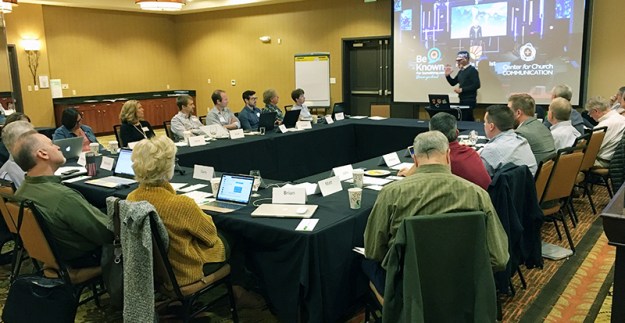
XPGatheringAt the first of two EPC Executive Pastor/Church Administrator Roundtable workshops held this fall, veteran church communicator Mark MacDonald discussed the importance of strategic, intentional communications to a local church’s efforts in effectively reaching its community as well as its members and attendees.

MacDonald is Executive Director of the Center for Church Communication, and is author of the Amazon best-seller Be Known for Something. He serves as Strategic Communication Catalyst for the Florida Baptist Convention, which serves more than 3,000 Florida Southern Baptist Churches.

The roundtable, now in its sixth year, is a two-day workshop for EPC executive pastors, church administrators, and others in senior ministry operations leadership positions.

Phil VanValkenburg, EPC Chief Operating Officer, hosts the event each year.

“We believe in the biblical principle that ‘iron sharpens iron,’ and this event is an opportunity for our church leaders to hear from their peers who face many of the same issues as they do in their ministries,” VanValkenburg said. “As we continue to focus on effective biblical leadership as one of our strategic initiatives, by being ‘better together’ we glean from each other’s experience—and our churches receive the benefit.”

Twenty-four EPC church leaders participated in the workshop October 18-19 in Denver, Colo. Participants discussed their specific ministry victories and challenges, shared best practices on a variety of topics related to church administration, and networked on such issues as technology systems, personnel, culture, vision and strategy, finance, generosity, and many others.

The workshop is a resource of the Office of the General Assembly. The second roundtable takes place November 1-2 in Orlando. For last-minute registration possibilities, contact marti.brenner@epc.org.

Pray for Andrew Brunson

 
BillCampbell

Bill Campbell

by William P. (Bill) Campbell

It was July 18, 2018. I sat in the cavernous Aliağa courtroom in Western Turkey, watching Andrew Brunson boldly testify to the gospel of salvation and forgive the Turkish officials for persecuting him without cause. It was a message that needed to be heard by everyone, I thought. I was glad so many were listening in: a group of officials and witnesses at the stand, the armed guards, and the entourage of reporters, Turkish pastors, and varied observers in the aluminum bleachers in back of the courtroom.

How powerful it would be if the world could catch the spirit behind Andrew’s words.

It can! Maybe not come from the flurry of news media that followed the hearing, or from the transcribed court proceedings that will serve as public record in Turkey. I am referring rather to the influence of your life and mine as we pray for Andrew’s release. Every day that Andrew is detained in Turkey and God’s people pray, it is not only the American government that is being influenced to action. The God who reigns over the nations also is being stirred to action—hopefully to free Andrew, impact Turkey, and change each of us. Our prayers are His pen through which He can transcribe truths on our hearts. Realize this:

  1. Andrew and the pastors in that courtroom set a high bar for boldness that should inspire us to be more fearless as we live for the Lord with all of our freedoms. In the courtroom, the pastor who interpreted for me had already offered himself as a witness in Andrew’s case. He knew that in so doing, he put himself under the careful scrutiny of a government that is making it very difficult to be a Christian. Each of the Turkish pastors present with me had already spent time behind bars because of their faith. At any point, one or all might face prison for the rest of their lives. And Andrew, if not released, faces a 35-year prison term. Interceding for such courageous believers can birth courage in our hearts.
  2. Andrew’s predicament can also remind us to pray for Turkey. Several days of conversations I had with Turkish believers revealed a deep-seated concern that Andrew’s case may be evidence of a growing anti-Christian sentiment in the country. According to accounts I heard, Turkish citizens who have offered even a mere suggestion on social media that they are not happy with the current situation in Turkey are often required to begin reporting every few days to a government office confirming that they are fully supportive of the government. One more slip and they may find themselves joining company with more than 150,000 others who have been detained or imprisoned on various charges since the attempted overthrow of the government in July of 2016. Surely as we pray for Andrew, we must pray for Turkey.
  3. When we pray for Turkey, we will quickly find ourselves praying for the world. Turkey is a gateway to both East and West. It was originally from Turkey that Christianity was launched around the globe. It was there also that the first seven councils of the church were held. Oddly, Turkey—the cradle of early Christianity—is now one of the least-Christian countries in the world. There are nearly as many active churches in the small town from which I write, Hendersonville, N.C., as there are in the entire nation of Turkey (about 250). Depending on how “Christian” is defined, Turkey is between 0.2 and 0.4 percent Christian. The stark contrast between what was and what is may seem depressing, but it should actually give us great hope. An old Korean proverb says, “Where water once flowed, it can flow again.” Let us pray for God to bless the beautiful land of Turkey and all of its people. Let us offer petitions to Him for that nation with this realization: what God has done before, God can do again. May Turkey continue as a democracy, may all peoples be welcome there, and may the Church flourish.
  4. Praying for Andrew may cause us to recognize how quickly we may lose our freedoms if we don’t stand strong in our faith. Sadly, the Church in America tends to be influenced by its culture more than it influences culture. We must once again heed the messages found in the letters to the seven churches as recorded in Revelation 2-3. By the way, each of these seven churches was situated in what is now Turkey. Only partially uncovered ruins remain in each location. But the truths in those letters live on. They call us to be genuine Christians—willing to follow Christ even when things are tough and when we face slander, opposition, and difficulty.

Conclusions for Today

It is natural to become discouraged in our prayers for Andrew as we experience delay after delay. It is supernatural, however, to realize that God is at work for good—even on Andrew’s behalf—and that our prayers are being heard. The sovereign God who used Joseph’s imprisonment (Genesis 39) as part of His greater purpose can and will use Andrew’s detention in ways we have not anticipated and may never fully understand. God is at work. And we must never give up.


Campbell serves as Pastor of Hendersonville Presbyterian Church in Hendersonville, N.C. He also is the founder and president of Scripture Awakening, a ministry that provides resources to help people read, study, and live the Scriptures. 

Prayer Guides and other resources, including an in-depth, 31-day prayer initiative for Andrew and Turkey, are available at www.epc.org/freepastorandrew.

EPC issues Call for Prayer and Fasting ahead of October 12 Andrew Brunson hearing


AndrewBrunsonPrayerGuide201810HorizontalThe trial of Andrew Brunson, EPC Teaching Elder imprisoned in Turkey since October 2016, resumes on Friday, October 12. In an effort to stand with and pray for the Brunson family, the EPC is issuing a Call to Prayer and Fasting for the week of October 8.

“Recent speculation in the media that Andrew could be released on October 12 should cause us to ramp up our prayer efforts,” said Jeff Jeremiah, EPC Stated Clerk. “We all desperately want that outcome, so I hope that every one of our 600 congregations will participate in this week of prayer and fasting.”

Six specific prayers are suggested for the days leading to the October 12 hearing:

  • Pray for Andrew and Norine’s continued physical safety, as well as perseverance in prayer and protection from discouragement.
  • Pray for God to prepare all of the players in the trial: the prosecution, the defense, every witness, and Andrew himself. Pray for God’s wisdom to prevail over all aspects of the trial.
  • Pray for Andrew to be emboldened to give a clear gospel witness, and that those in attendance (including media, guards, attorneys, and others) would hear and understand the gospel message.
  • Pray for media representatives at the trial to be safe, and for journalists to write reports that will glorify God.
  • Pray that unless the Lord has a purpose in keeping Andrew in Turkey, that he will be released from his current house arrest, allowed the freedom to travel, and acquitted of the charges.
  • Pray that God will use the trial and its outcome to open doors for the gospel in Turkey.

Prosecutors in the case have asked for a 35-year prison sentence on charges that Brunson helped terrorist organizations and worked to convert Turks to Christianity.

A printable bulletin insert in pdf format with these Scripture prayers can be downloaded at www.epc.org/news/freepastorandrew.

Also available is an in-depth, 31-day prayer initiative for Andrew and the nation of Turkey, which was developed by EPC Teaching Elder William P. (Bill) Campbell. Campbell serves as Pastor of Hendersonville (N.C.) Presbyterian Church, and also is the founder of Scripture Awakening, a ministry that offers resources to help people read, study, and live the Scriptures. Campbell attended Andrew’s trial on July 18, 2018, in Aliağa, Turkey.

‘Pray for Andrew Brunson’ wristbands available at epcresources.org


Wristband-PrayForAndrewBrunsonE600In response to high demand following the 38th General Assembly, “Pray for Andrew Brunson” wristbands are now available at www.epcresources.org. The blue flexible wristbands were provided for GA Commissioners and guests as part of their registration materials.

“I was blessed by the positive response to the wristbands from GA attendees,” said EPC Stated Clerk Jeff Jeremiah. “Many people told me they wanted to take some home to their churches to show their support for Andrew, but we just didn’t have enough. We are very pleased to be able to make them available again, especially with Andrew’s trial resuming on July 18.”

Cost per band is 25 cents, plus shipping. Click here to order.

AndrewBrunsonWristband

EPC issues call to prayer and fasting for April 15 ahead of Andrew Brunson trial

 
AndrewBrunsonOctober2017

Andrew Brunson

On April 16, 2018, EPC Teaching Elder Andrew Brunson will go on trial in Izmir, Turkey. If convicted of the charges in the 62-page indictment filed by the prosecutor, Andrew could be sentenced to 35 years in prison. The indictment charges Brunson with helping terrorist organizations and of trying to convert Turks to Christianity.

In an effort to stand with and pray for the entire Brunson family, the EPC is issuing a Call to Prayer and Fasting for Sunday, April 15. The trial is scheduled to begin at 9:00 a.m. local time in Turkey, which is 2:00 a.m. EDT Monday.

Jeff Jeremiah, EPC Stated Clerk, said Andrew’s wife, Norine, has requested three specific prayers:

  • Pray for Andrew’s release, using Psalm 18, which speaks of deliverance from the “cords of death” (v. 4-5).
  • If he is given the opportunity to speak in his defense, please claim Jesus’ promise, “But make up your mind not to worry beforehand how you will defend yourself. For I will give you words and wisdom that none of your adversaries will be able to resist or contradict” (Luke 21:24-15).
  • That the steadfast love of the Lord will comfort our children (Jordan, Jaqueline, and Blaise) and that He will give them peace and help them to trust.

“As we consider Norine’s steadfast faithfulness and courage, my prayer is that she not grow weary,” Jeremiah said. “I have been claiming Galatians 6:9 and Exodus 17:12 for her, and she knows that we are helping ‘hold up her arms’ for her husband.”

In addition to the April 15 Day of Prayer and Fasting, a seven-day prayer guide for the week leading up to the trial can be downloaded at www.epc.org/files/andrewbrunson7dayprayerguide.

“I encourage the Prayer Team of every EPC church to utilize this guide and lift Andrew, Norine, their family, and the trial to the throne of our Lord and Savior Jesus Christ,” Jeremiah said.

Seminary programs benefit EPC students preparing for ministry


Partnerships between the EPC and two evangelical seminaries offer significant financial savings for those pursuing formal theological education.

MAPThe EPC’s Mentored Apprenticeship Program (MAP), de­vel­oped in collaboration with Gordon-Conwell Theological Seminary, makes eight specific ministry courses available online at half the normal cost of tuition. These courses—dis­cipleship, ethics, leadership, pastoral care/counseling, ministry as mission, apologetics, preaching, and evangelism—may be taken while at­tending any other seminary and are all transferrable according to Association of Theo­logical Schools (ATS) rules.

The EPC’s new requirements for ordination to the office of Teaching Elder, approved by the 36th General Assembly in response to changing trends in theological education nationwide now require the completion of these eight courses.

RTSIn addition to MAP courses through Gordon-Conwell, the Andrew Jumper Scholarship is available for EPC-affiliated students at Reformed Theological Seminary (RTS). The scholarship is a full-tuition award for an incoming, residential Master of Divinity (MDiv) student at any RTS campus, and is named for the EPC “Founding Father” and longtime pastor of Central Presbyterian Church in St. Louis, Mo.

Candidates for the Jumper Scholarship should be members in good standing of an EPC church, under care of an EPC presbytery, and must demonstrate future commitment to the EPC. The deadline for application is March 15 for entry into the MDiv program in the following summer or fall.

Brian Gault, RTS Director of Financial Aid, said the scholarship exists because of the generosity of donors who care for the preparation of future pastors in the EPC, adding that additional donations to the scholarship fund directly support students.

“As the fund grows, we can support more students,” he said. “Wouldn’t it be amazing if future EPC ministers never had to pay for tuition to attend RTS?”

Kent Mathews, Pastor of the EPC’s Grace Community Fellowship in Ottawa, Kan., serves as the Director of MAP. He noted that the online MAP courses not only involve the same types of readings, videos, and assignments encountered in a traditional seminary course, they also involve a mentored relationship with a local pastor or other ministry leader, as well as in-the-field ministry project for each course.

“Research demonstrates that the top three things seminary students currently wish of their education are reduced tuition, a relation­ship with a mentor, and the opportunity to gain practical experience in the subjects they are studying” he said.

“The MAP course projects help students gain that practical ministry experience in their local context, and because they are offered at half the normal cost of tuition, it is literally like receiving a $7500 scholarship.”

Mathews added that a student completing at least six of the eight MAP courses will earn a Certificate of Completion from Gordon-Conwell. He emphasized that a student does not need to be a pursuing a master’s degree—or even have a bachelor’s degree—to take the courses, making it an ideal training vehicle for even non-ordained church or parachurch staff who want to improve their skills and knowledge.

Gordon-Conwell operates campuses in Hamilton, Mass; Boston, Mass.; Charlotte, N.C.; and Jacksonville, Fla. (Registration for MAP courses is through the Charlotte campus.) For more information, contact Mathews at kentmathews@sbcglobal.net or 785-418-1635.

Reformed Theological Seminary offers the MDiv degree at its campuses in Jackson, Miss., Orlando, Fla.; Charlotte, N.C.; Atlanta, Ga.; Washington, D.C.; Dallas, Texas; and Houston, Texas. For more information about the Jumper Scholarship, contact Gault at bgault@rts.edu.

Executive Pastor/Church Administrator Roundtable features church leadership expert Mike Bonem


XPRoundtableAt the first of two EPC Executive Pastor/Church Administrator Roundtable workshops held this fall, noted church leadership coach and consultant Mike Bonem discussed the joys and challenges of the “second chair” role. He defined a Second Chair Leader as “a person in a subordinate role whose influence with others adds value throughout the organization.”

Bonem earned an MBA from Harvard University, is a longtime business executive, and later served 11 years as Executive Pastor for a large church in Houston, Texas. He is author of Leading from the Second Chair, Thriving in the Second Chair, In Pursuit of Great and Godly Leadership, and Leading Congregational Change.

The roundtable, now in its fifth year, is a two-day workshop for EPC executive pastors, church administrators, and others in senior ministry (but second-chair) leadership positions.

Phil VanValkenburg, EPC Chief Operating Officer, hosts the roundtable each year.

“We want our church leaders to know that they have peers who face many of the same issues as they do in their ministries,” VanValkenburg said. “As we continue to focus on effective biblical leadership as one of our strategic initiatives, by being ‘better together’ we glean from each other’s experience and each of their churches gets great benefit.”

Twenty EPC church leaders participated in the workshop October 26-27 in Denver, Colorado. Participants discussed their specific ministry victories and challenges, shared best practices on a variety of topics related to church administration, and networked on such issues as technology systems, personnel, vision and strategy, finance, and many others.

The workshop is a resource of the Office of the General Assembly. The second roundtable takes place November 16-17 in Orlando.